
Talk to our team800-428-5367
Timeless classic ceiling lights do more than fill an empty spot overhead. They shape how a room feels at breakfast, during a quiet evening, and when guests gather beneath warm, diffused light. Aged brass, milk glass, and simple flush mounts can look enduring without feeling old-fashioned. But a classic shape is not automatically the right choice. Ceiling height, room scale, and the light’s direction matter.
Energy performance deserves attention, too. The U.S. Department of Energy’s Energy Saver guidance says LED lighting uses at least 75% less energy and lasts up to 25 times longer than incandescent lighting. Those figures describe LED technology, not every fixture on the market; check the specifications before buying. A dimmable LED chandelier may suit a dining room, while a low-profile fixture can leave more visual space in a hallway.
Architect Louis Kahn said, “A room is not a room without natural light.” His observation is a useful reminder: ceiling fixtures should complement daylight, not compete with it. A pendant that casts a sharp shadow across a kitchen counter may be beautiful, yet frustrating in daily use. Small details matter. This guide explores 10 timeless classic ceiling lights, from opal-glass globes to traditional chandeliers, with attention to style, function, and practical fit. The best choice may not be the most dramatic one. It should feel right in your home, even on an ordinary Tuesday.
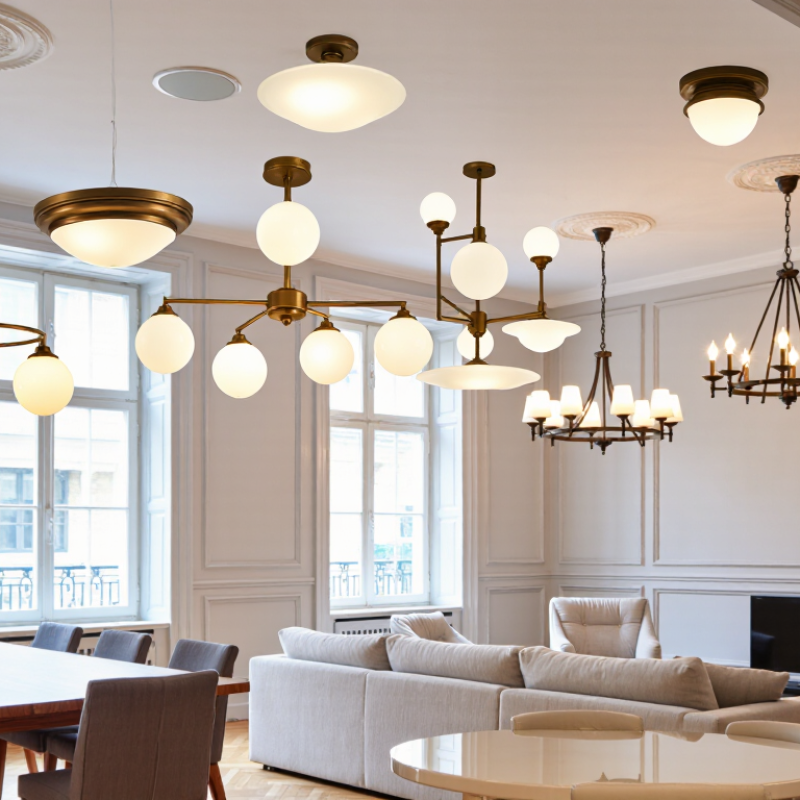
Classic ceiling lights are best understood through their mounting style, materials, and design era—not simply by a traditional-looking shade. Flush mounts sit close to the ceiling, making them practical for low rooms and hallways. Semi-flush fixtures drop slightly, leaving space for a visible stem and soft shadows above the shade. Chandeliers hang lower and suit rooms with enough clearance. Scale matters.
Materials offer useful clues. Brass, bronze, cut glass, milk glass, and painted metal appear in many enduring designs, though finishes and details vary across periods. A ribbed glass bowl may soften light in a kitchen, while a metal dome can direct it downward over a table. Check how a fixture is assembled and how its finish looks in daylight; photographs can hide uneven color or delicate joints. Small details count.
Design era adds another layer. Georgian-inspired forms often favor symmetry, while Victorian fixtures may use richer ornament and layered glass. Mid-century designs tend toward cleaner lines and simpler shapes. These categories overlap, and a modern reproduction may borrow features from several eras. That can be appealing, but it makes “classic” a flexible label rather than a precise date. Match the fixture’s height and light spread to the room, then consider whether its materials and silhouette feel at home with the existing furniture.
| Classic Style | Mounting Style | Typical Materials | Design Era | Defining Features | Often Suited To |
|---|---|---|---|---|---|
| Opal Glass Globe | Flush or semi-flush mount | Opal or milk glass; brass, nickel, or steel fittings | Early to mid-20th century influence | A rounded diffuser softens the light and conceals the bulb. | Hallways, bedrooms, and rooms with lower ceilings |
| Schoolhouse Pendant | Suspended pendant | Milk glass or clear glass; metal canopy and stem | Late 19th to early 20th century | A practical shade, often with a broad lower opening, directs light downward. | Kitchens, breakfast areas, and utility spaces |
| Traditional Chandelier | Suspended from a chain or rod | Brass or iron; sometimes cut or pressed glass | Forms developed over several centuries; popular in European interiors from the 17th century onward | Multiple arms carry several lamps around a central frame. | Dining rooms, entry halls, and rooms with higher ceilings |
| Brass or Bronze Lantern | Pendant or chain-hung fixture | Brass or bronze frame; clear or seeded glass panels | Inspired by pre-electric gas and oil lanterns | An open, framed shape gives the light a defined architectural outline. | Entryways, stair landings, and covered porches when rated for the location |
| Arts and Crafts Fixture | Semi-flush mount or pendant | Wrought iron, bronze, copper, and handmade or textured glass | Late 19th to early 20th century | Emphasizes simple geometry, visible craftsmanship, and natural materials. | Bungalows, craftsman-style homes, and cozy living areas |
| Art Deco Ceiling Light | Flush mount, semi-flush mount, or pendant | Chrome, nickel, brass, and etched or frosted glass | 1920s–1930s | Uses symmetry, stepped forms, and crisp geometric detailing. | Dining rooms, foyers, and interiors with geometric details |
| Mid-Century Modern Sputnik | Ceiling-mounted branching fixture | Brass or steel arms with exposed glass bulbs | Mid-20th century, especially the 1950s and 1960s | Radiating arms create a starburst silhouette and distribute light in several directions. | Living rooms, dining spaces, and mid-century-inspired interiors |
| Drum Shade Fixture | Flush mount, semi-flush mount, or pendant | Fabric or parchment-style shade; metal frame and diffuser | A versatile form used in traditional and 20th-century interiors | A cylindrical shade gives a clean outline and can diffuse light above and below. | Bedrooms, living rooms, and spaces needing softer general light |
| Ribbed or Prismatic Glass Fixture | Flush or semi-flush mount | Ribbed, pressed, or prismatic glass; metal base | Common in early 20th-century commercial and domestic lighting | Textured glass helps spread light and adds visual detail without a large profile. | Bathrooms, corridors, and compact rooms |
| Simple Porcelain or Ceramic Fixture | Surface-mounted flush fixture | Glazed porcelain or ceramic; exposed metal hardware | A longstanding utilitarian form, especially familiar in early electric interiors | A compact, straightforward shape prioritizes function and easy maintenance. | Laundry rooms, pantries, workshops, and simple hallways |
Selection note: “Best” depends on ceiling height, room size, desired light distribution, and the home’s interior style. Check the fixture’s installation instructions and location rating, especially in bathrooms and outdoor areas.
Mounting style, materials, and design details matter more than a traditional-looking shade. Classic forms can borrow from several eras.
Flush mounts sit close to the ceiling, so they work well in low rooms and hallways. Semi-flush lights hang slightly lower.
Ribbed glass can soften light in a kitchen. A metal dome often directs light downward over a table. Check finishes in daylight.
Add the room’s length and width in feet. Use the total as an approximate diameter in inches. A 12-by-14-foot room suggests about 26 inches.
Not by itself. Compare the fixture width with the tabletop and leave comfortable clearance. Marking the proposed size with tape can help.
A CRI of 80 or higher is a useful benchmark. Color temperature also affects how the light feels at night. CRI is not the whole story.
No. Check that the fixture, bulbs, and dimmer are compatible. Otherwise, the light may flicker, buzz, or dim unevenly.
Look for a safety listing that applies to the complete fixture. Follow installation instructions, and check suitability for damp rooms. Also consider cleaning and heat.
Timeless classic ceiling lights bring enduring style to a home through a balance of shape, materials, and proportion. Their look may draw on different design eras, while mounting styles range from close-fitting flush mounts to semi-flush fixtures and suspended chandeliers. Familiar options include lanterns, domes, schoolhouse shades, drum lights, and glass or metal designs, making it possible to find a fixture that suits both traditional and contemporary rooms.
Choose a fixture size by adding the room’s length and width in feet; use the result in inches as a helpful starting point for the fixture’s diameter. Then consider light output in lumens, a warm color temperature of about 2,700–3,000 K, and a CRI that renders colors clearly. Look for a CRI of at least 80, confirm the fixture supports dimming if desired, and check that it carries appropriate safety listings. These practical checks help ensure classic style also delivers comfortable, dependable lighting.
