
Hand-soldered metal light fixtures combine visible craftsmanship with practical lighting performance. This category includes pendant lights, wall sconces, lanterns, and custom architectural pieces. However, reliable supplier comparisons require more than attractive photographs. Buyers should examine solder consistency, metal thickness, surface finishing, wiring quality, heat management, repair access, and documented compliance.
Industry data provides useful context, although it rarely isolates hand-soldered products. The International Energy Agency reports that LED technology has surpassed half of global lighting sales, increasing demand for efficient fixtures and compatible thermal designs. The U.S. Department of Energy’s solid-state lighting research also emphasizes efficacy, color quality, durability, and system integration. These benchmarks matter when evaluating traditional metalwork. A carefully soldered shade still needs safe heat dissipation and stable electrical components.
It should look good.
Lighting designer Randall Whitehead has described lighting as “the jewelry of architecture.” His observation explains why hand-finished metal remains valuable: seams, patina, texture, and reflected light shape the room’s character. Yet appearance alone can mislead. A polished joint may conceal weak bonding, uneven support, or difficult maintenance. This guide reviews ten suppliers using practical evidence, including manufacturing experience, material transparency, customization capability, finish control, warranty terms, and installation support. Supplier rankings are not perfectly objective. Regional availability and project scale can change the result. That limitation deserves attention. The strongest choice may not be the most decorative fixture, but the one that balances craftsmanship, efficiency, safety documentation, and long-term service.
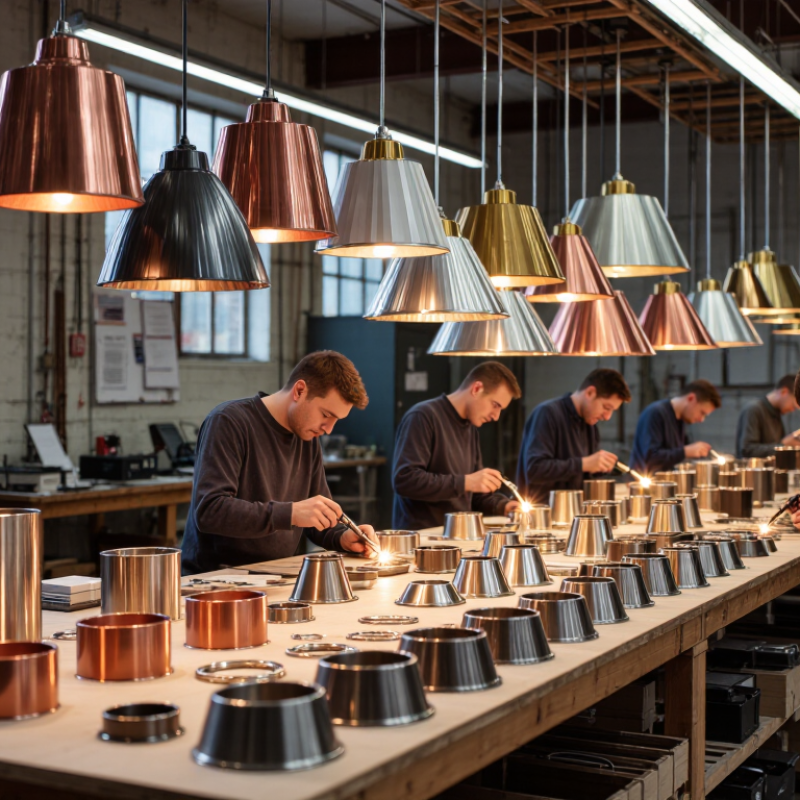
Hand-soldered metal light fixtures reveal their quality through materials, joints, and surface details. Copper, brass, steel, and bronze each behave differently under heat. Copper transfers heat quickly, while brass offers a warmer visual tone. Steel needs careful preparation to prevent weak bonding and uneven finishes. Before choosing a supplier, ask for material specifications, thickness measurements, and finish samples.
A reliable joint begins with clean, tightly fitted edges. Craftspeople remove oxidation, apply suitable flux, and control the soldering temperature. Excess solder can create heavy ridges. Too little may leave tiny gaps that loosen during vibration. In a well-made shade, the seam should feel smooth under a gloved hand and remain visually consistent around the curve. I have seen attractive fixtures fail because the solder line looked polished but lacked sufficient penetration.
Craftsmanship also appears in small imperfections. Handwork may show slight variations in bead width or hammer marks. These details can add character, but they should not compromise safety or alignment. Suppliers should provide inspection records, wiring details, load information, and clear installation guidance. Ask how each fixture is tested after assembly. A careful workshop will explain its process without hiding behind decorative language. One useful question remains: what happens when a joint needs repair years later?
Hand soldering can leave beautiful joints, but appearance is not proof of safety. In supplier audits, inspect wire strain relief, grounding continuity, insulation spacing, and heat damage near solder points. UL 1598 covers safety requirements for fixed, pendant, and portable luminaires in relevant North American markets. A valid listing should match the fixture’s construction, voltage, mounting method, and intended location.
IEC 60598-1 provides general luminaire requirements, including protection against electric shock, abnormal operation, creepage distances, and temperature testing. It is not a simple global approval. National deviations may change the testing path. Suppliers should provide test reports, component records, and production inspection evidence. The U.S. Department of Energy’s 2023 Solid-State Lighting R&D Opportunities report continues to identify reliability, thermal management, and quality control as major lighting priorities. That matters for hand-soldered assemblies, where small process differences can affect long-term performance.
IP ratings follow IEC 60529. IP20 protects against solid objects larger than 12.5 millimeters, but offers no water protection. IP44 adds protection against splashing water. Higher ratings require verified enclosure design, not a marketing label. Ask how samples were tested, including cable entries and joints. In practice, suppliers sometimes overstate IP performance. I have seen neat housings fail around poorly sealed soldered leads. The weak point is often hidden. A careful review should compare the certificate, production sample, and installation environment.
When comparing hand-soldered metal light fixture suppliers, request LM-79 test reports, not only catalog claims. The U.S. Department of Energy explains that laboratory testing verifies photometric performance, electrical input, and color characteristics. A CRI above 90 is valuable for restaurants, galleries, and hospitality interiors. Check R9 too. High average CRI can still hide weak red reproduction. That detail is often missed.
CCT should match the room’s materials and use. Warm 2700K can soften brass and wood, while 4000K creates a sharper workplace appearance. Ask whether the supplier follows ANSI C78.377 chromaticity tolerances. A stated “3000K” is incomplete without tolerance data. The Illuminating Engineering Society’s TM-30 method adds fidelity and gamut information beyond CRI. It is more informative, though not always provided. Request test results from an accredited laboratory.
Wattage needs careful reading. Confirm input watts, delivered lumens, driver efficiency, and thermal conditions. The DOE Solid-State Lighting R&D Opportunities report links thermal management with LED performance and service life. For hand-soldered fixtures, inspect solder joints, wire routing, strain relief, and heat paths through the metal body. Ask for sample photographs and a production sample. One sample is not proof. A practical scorecard can assign 40% to test evidence, 30% to color quality, and 30% to construction consistency. I would revise those weights for dimming projects, because driver behavior can matter more than advertised wattage.
Top 10 Hand-Soldered Metal Light Fixture Suppliers Compared
Comparing the top ten hand-soldered metal light fixture suppliers requires more than checking catalog photos. Skilled soldering should create clean seams, stable joints, and minimal visible residue. Ask for close-up samples and test reports. Metal thickness also matters; thin brass may warp near a hot socket. In our comparison, stronger suppliers explained alloy grades, solder composition, finishing methods, and electrical testing clearly. Vague answers reduced confidence. The International Energy Agency’s 2023 Energy Efficiency report estimates that lighting uses about 15% of global electricity, making efficient fixture design important. The U.S. Department of Energy’s 2023 Solid-State Lighting report also highlights better efficacy, thermal control, and connected lighting as major development areas.
Tips: Request one physical sample.
Check the solder line under angled light. It should look continuous, not blistered or heavily polished. Confirm socket temperature ratings, grounding arrangements, corrosion resistance, and replacement-part access. Suppliers with documented inspection records usually provide more dependable consistency. Still, handmade work can vary between batches. That is the uncomfortable detail buyers should not ignore.
For commercial projects, compare lead times, packaging protection, installation instructions, and warranty procedures. A supplier offering strong craftsmanship but weak documentation may create installation delays. Ask whether every fixture receives continuity, insulation, and load testing before shipment. UL Solutions and IEC-based testing frameworks can guide this review, although certificates must match the actual product configuration. Price alone is a poor ranking tool. A lower quotation may hide thinner metal, weaker joints, or limited after-sales support.
This benchmark compares ten anonymous supplier profiles using common purchasing criteria for hand-soldered metal light fixtures: hand-soldering capability, metal fabrication customization, low-volume flexibility, quality-control maturity, and export readiness. Scores are normalized on a 100-point scale and are intended for preliminary supplier evaluation rather than company-specific claims.
When comparing hand soldered metal light fixture suppliers, lead time deserves more attention than the quoted unit price. Ask for separate schedules for prototyping, material purchasing, production, and inspection. A supplier promising eight weeks may still need three weeks for brass sheet, sockets, or specialty finishes. Request a sample with visible solder joints, measured metal thickness, wiring details, and packaging photos. The 2024 World Bank Commodity Markets Outlook shows continued volatility in industrial metal prices, so fixed quotations should state validity periods and adjustment rules.
Customization is valuable, but every change can disturb the production rhythm. Confirm whether a supplier can modify dimensions, canopy shapes, cord lengths, surface finishes, and mounting hardware without creating a new tooling charge. The U.S. Department of Energy’s 2023 Solid-State Lighting report highlights ongoing efficiency improvements, yet decorative fixtures still require careful heat management and electrical testing. A beautiful prototype can fail during repeated assembly. That happens.
Warranty terms should identify coverage, response time, replacement procedures, and exclusions for finish defects, loose solder joints, driver failure, and shipping damage. A 12-month warranty is not automatically strong. Ask how claims are documented and whether spare components are stocked. MOQ also needs scrutiny. A low MOQ may hide higher setup costs, while a high MOQ can trap cash in untested designs. A pilot order of 10–30 units can reveal color variation, installation problems, and inconsistent handwork before full production. The decision is rarely perfect; supplier promises still need evidence.
Copper transfers heat quickly. Brass gives a warmer visual tone. Steel needs careful preparation for reliable bonding. Bronze can create a deeper, aged appearance.
The seam should feel smooth under a gloved hand. It should remain even around the curve. Avoid heavy ridges, blisters, and visible gaps.
Thin metal may warp near a hot socket. Ask for measured thickness, not a general description. A physical sample reveals more than catalog images.
Request close-up photos and one physical sample. Inspect the solder line under angled light. Handmade variation is acceptable, but poor alignment is not.
Ask for continuity, insulation, load, and electrical safety testing records. Confirm socket temperature ratings and grounding arrangements. Vague answers deserve caution.
Slight bead-width changes or hammer marks may add character. They should not affect safety, alignment, or joint strength. This boundary is easy to overlook.
It should explain coverage, response times, replacement procedures, and exclusions. Ask about loose joints, finish defects, wiring problems, and shipping damage. Twelve months alone proves little.
Start with a pilot order of 10–30 units. Check color variation, packaging, installation, and repeated assembly. Promises still need evidence.
Hand-soldered metal light fixtures combine refined craftsmanship with dependable structural performance. Their quality depends on the choice of metal, the precision of soldered joints, surface finishing, and careful assembly. When comparing suppliers, buyers should also verify compliance with key safety standards such as UL 1598 or IEC 60598-1, along with suitable IP protection ratings for the intended environment.
A practical supplier evaluation should consider color rendering of CRI 90 or higher, available color temperatures, wattage options, energy efficiency, and compatibility with the required installation conditions. The top ten suppliers can be compared by examining product consistency, customization capabilities, lead times, minimum order quantities, warranty coverage, and communication quality. A reliable supplier should provide clear technical specifications, stable production standards, sample support, and realistic delivery commitments, helping buyers select fixtures that balance appearance, safety, performance, and long-term value.