
Sales & Specification Support: 800-428-5367 A Division of American Lighting Brands 941 Cernan Drive, Bellwood, IL 60104  ·  Handcrafted since 1905
0%

China has become a major manufacturing base for architectural lighting, serving hotels, retail spaces, offices, museums, and public projects worldwide. The country offers extensive production capacity, integrated supply chains, and flexible customization. However, factory scale alone does not prove quality.

Custom architectural lighting requires more than an attractive fixture. It involves photometric performance, glare control, color consistency, thermal management, driver reliability, and accurate installation details. A recessed linear light may look simple, yet its housing tolerance can affect ceiling alignment by only a few millimeters. That small difference matters on a finished project. Professional suppliers should provide IES or LDT files, LM-80 or TM-21 references when applicable, product drawings, sample testing, and clear warranty terms.

Industry data supports the growing importance of efficient lighting. The International Energy Agency has reported that lighting represents roughly 15% of global electricity consumption, while LED adoption can significantly reduce energy demand. The U.S. Department of Energy’s solid-state lighting research also highlights improvements in LED efficacy, controls, and product life. Meanwhile, market studies from Grand View Research and MarketsandMarkets project continued growth in architectural and smart lighting, although their figures differ by definition and region. That variation deserves attention.

The best Chinese suppliers combine engineering experience with verified production control. They understand hospitality timelines, local electrical requirements, and the practical limits of bespoke design. No supplier list is perfect. Buyers should still inspect samples, audit documentation, and test critical components before approval. A reliable partner proves performance in the ceiling, not only in a polished catalogue.
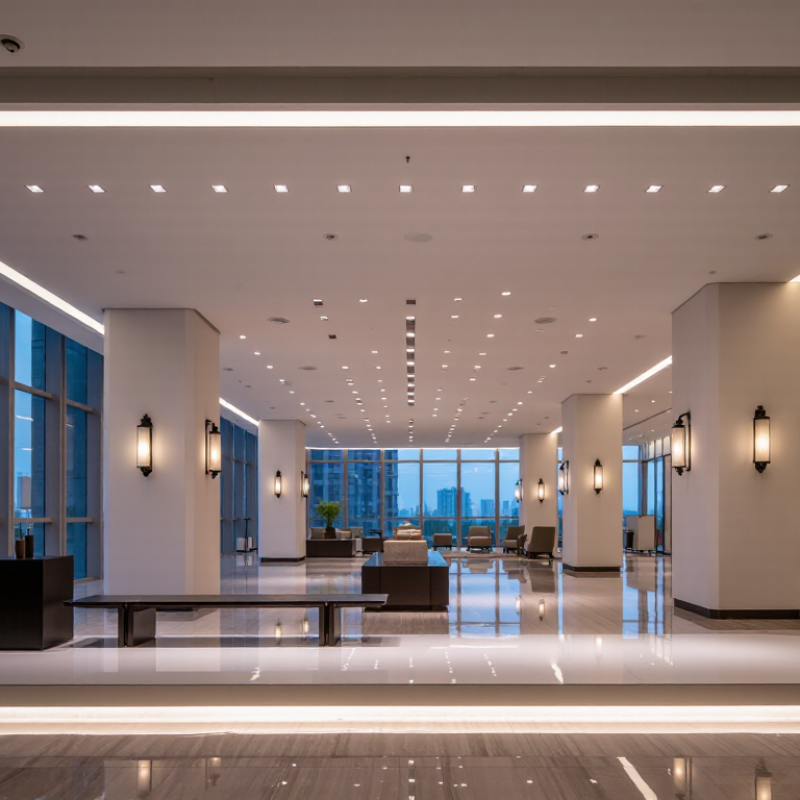
China Best Custom Architectural Lighting Suppliers

China’s Custom Architectural Lighting Supplier Market and Buyer Criteria

China’s custom architectural lighting supplier market is expanding with demand for energy efficiency, smart controls, and project-specific design. Fortune Business Insights estimates the global architectural lighting market could grow from about USD 8.3 billion in 2023 to USD 13.0 billion by 2032. This growth raises buyer expectations for Chinese manufacturers. Customization now means more than changing a housing color. It includes beam angles, dimming protocols, optics, mounting details, and control integration.

A serious buyer should request IES or LDT photometric files before approving samples. Check CRI, CCT tolerance, UGR performance, lumen maintenance, and thermal testing. For outdoor projects, IP ratings and corrosion resistance need supporting reports. The U.S. Department of Energy states that LED products can use at least 75% less energy and last up to 25 times longer than incandescent lighting. However, efficiency claims still require independent test evidence. Ask for LM-80 data, warranty terms, production records, and a clear replacement process. Small details matter.

Factory visits can reveal assembly discipline, soldering quality, aging-test areas, and packaging protection. A low unit price looks attractive. It may hide weak drivers or unstable color consistency. Buyers should compare total project cost, not only the quotation. I would also test one full mock-up under real ceiling conditions. Computer simulations are useful, but they can miss glare near polished stone surfaces. China-based suppliers become more reliable when technical communication, quality checkpoints, and delivery responsibilities are written clearly. Some specifications will still change; that is normal, but undocumented changes create avoidable risk.

LED Performance: 100+ lm/W Efficacy, CRI ≥90, and CCT Selection

China Best Custom Architectural Lighting Suppliers

For architectural projects, LED performance begins with measurable data, not attractive renderings. A capable custom lighting supplier should provide tested efficacy above 100 lm/W at the complete fixture level. Ask whether the figure includes the driver, optics, housing, and thermal losses. That detail matters. A high chip rating alone can mislead.

CRI of 90 or higher helps reveal stone, wood, fabric, and painted surfaces with greater accuracy. For galleries and hospitality interiors, request R9 data as well. Strong red rendering often affects skin tones and warm materials. CCT selection should match the space, not merely follow a catalog. Specify 2700K for intimate areas, 3000K for balanced comfort, or 4000K for task-focused environments. Tunable white may support changing scenes, but it adds controls, wiring, and maintenance demands.

During supplier evaluation, request photometric files, test evidence, binning details, and a sample at the proposed wattage. Inspect the sample at eye level. Check glare, color consistency, dimming behavior, and heat after several hours. Specifications can look perfect on paper. Reality is less tidy. I have seen efficient fixtures lose visual quality through narrow optics and poor installation. A reliable supplier discusses these compromises openly, offers repeatable production controls, and documents changes before approval. Ask for a small mock-up before full production. It may expose an uncomfortable assumption early.

Compliance Requirements: IEC 60598, CE, RoHS, and IP65 Protection

China’s best custom architectural lighting suppliers treat compliance as a design requirement, not a final paperwork exercise. IEC 60598-1 covers essential luminaire safety, including insulation, wiring, thermal performance, and mechanical construction. The IEA’s Energy Efficiency 2023 report states that lighting uses roughly 15% of global electricity. It also reports that LED lighting can be at least 75% more efficient than incandescent technology. Efficiency still depends on reliable drivers and proper heat management.

Evidence matters more. CE marking shows conformity with applicable European Union requirements; it is not a universal quality certificate. Suppliers should provide risk assessments, technical files, and relevant test reports.

RoHS compliance controls ten restricted substances, including lead, mercury, and certain flame retardants. Material declarations should match the exact housing, cable, coating, and driver used in production. Substituting components later can quietly break compliance.

For outdoor projects, IP65 means dust-tight protection and resistance to water jets under IEC 60529. It does not guarantee protection against immersion, condensation, or poor installation. In practical inspections, check cable glands, silicone seals, screw torque, drainage paths, and sample aging results. A missing gasket can invalidate an otherwise excellent design. No factory is flawless. The stronger suppliers record corrective actions, repeat tests after design changes, and explain limitations honestly. A 2024 project review should also question whether laboratory reports represent the final customized model, rather than an earlier sample.

Customization Workflow: Photometric Files, Prototypes, and Batch Testing

China Best Custom Architectural Lighting Suppliers

Customization Workflow: Photometric Files, Prototypes, and Batch Testing

A dependable architectural lighting supplier treats customization as a measured process, not a decorative promise. The workflow often begins with IES or LDT photometric files. These files show beam angle, luminous output, distribution, and glare performance. Project teams can test them in lighting software before ordering physical samples. This saves time, although simulations cannot reveal every installation problem.

Experienced engineers then review ceiling height, mounting details, surface finishes, and required color temperature. A prototype should match the proposed housing, lens, driver, and control system. Check the actual beam edge. Look for visible hotspots. A sample may expose an issue that drawings missed. That is useful evidence, not failure. Small changes in lens thickness or reflector geometry can alter the result significantly.

Before mass production, suppliers should approve a documented sample and define inspection points. Batch testing may include output, CCT consistency, dimming response, electrical safety, and thermal behavior. An integrating sphere can verify light performance, while a goniophotometer can confirm distribution. Random samples from each production batch provide stronger evidence than testing one perfect unit. Keep the records. They support traceability when a project contains hundreds of fixtures. Still, testing plans should be reviewed honestly, because factory conditions and installation environments are never identical.

Custom Architectural Lighting Workflow: Photometric Files, Prototypes, and Batch Testing

Each stage uses measurable quality indicators: photometric documentation coverage, prototype approval, and batch-test pass rate. The values represent practical workflow targets for custom architectural lighting projects.

Supplier Evaluation: MOQ, Lead Time, Warranty, and LM-80/TM-21 Data

China Best Custom Architectural Lighting Suppliers

When evaluating custom architectural lighting suppliers in China, MOQ, lead time, warranty, and testing evidence deserve equal attention. A low MOQ may support mock-ups, but it can increase unit costs and reduce production efficiency. I have learned that quoted lead times often exclude tooling approval and sample revisions. Request separate timelines for drawings, prototypes, certification, and mass production. For complex profiles, 30 to 60 days is a more realistic planning range than a simple factory promise.

Warranty terms should identify coverage, operating hours, lumen maintenance, and replacement procedures. The U.S. Department of Energy’s Solid-State Lighting R&D Opportunities report identifies 200 lumens per watt as a research benchmark for future systems. Efficiency claims still need project-specific verification. Ask for LM-80 reports covering the actual LED package, drive current, temperature, and test duration. Then review TM-21 calculations for projected lumen maintenance. LM-80 is measured data. TM-21 is a projection.

Look for test reports from qualified laboratories, not only supplier spreadsheets. The Illuminating Engineering Society standards explain why thermal conditions strongly influence LED life. A five-year warranty means little if the driver, housing, and control system remain undefined. Check whether the warranty starts at shipment or installation. That detail matters. I would also compare pilot-batch results with production-batch results, because consistency can weaken after customization. My evaluation is not perfect, especially when supplier documentation is incomplete, so I record missing evidence instead of treating silence as compliance.

China Best Custom Architectural Lighting Suppliers - Supplier Evaluation: MOQ, Lead Time, Warranty, and LM-80/TM-21 Data

Supplier Profile Typical Custom MOQ Sample Lead Time Production Lead Time Warranty Term LM-80 Documentation TM-21 Projection Photometric Evidence Customization Capability Evaluation
Profile A
Small-batch project manufacturer
10–30 units per SKU 7–12 working days 25–35 working days after approval 3 years standard; extended terms negotiable Available upon request for the selected LED package or module; verify test duration, case temperature, drive current, and lumen-maintenance curve Available for qualified LED packages; projection must identify the applicable LM-80 report and TM-21 calculation method IES files and integrating-sphere reports typically available for approved samples Custom dimensions, finishes, optics, CCT, CRI, dimming, and mounting details Suitable for prototypes and boutique projects
Profile B
Mid-sized OEM/ODM supplier
50–100 units per SKU 10–18 working days 35–50 working days after design freeze 5 years for complete luminaires under stated operating conditions Usually supplied as a third-party LED package/module report; confirm that the tested product family matches the proposed LED source Normally included in the technical submittal; confirm reported L70/L80 values are projections rather than field-life guarantees IES/LDT files, lumen output, power, efficacy, beam angle, and color data commonly available Extrusion tooling, reflector or lens development, DALI/0–10 V options, and project-specific finishes Balanced option for commercial projects
Profile C
High-volume architectural lighting factory
100–300 units per SKU 15–25 working days 45–65 working days after tooling and approval 5 years standard; project warranty may require defined ambient and operating limits Formal LM-80 files are generally available for major LED packages; verify report authenticity, tested current, temperature, and product-family applicability Detailed TM-21 calculations may be available; request the underlying LM-80 report instead of accepting only a lifetime number Photometric files, thermal data, electrical test results, and sample-based reports typically available Complex profiles, tooling, tunable white, emergency versions, smart controls, and large project production Strong choice for repeat orders and large developments
Profile D
Design-led specialist workshop
5–20 units per design 12–20 working days 30–45 working days, depending on materials and finish 2–3 years; clarify coverage for finish, drivers, LED modules, and labor May rely on the LED component supplier’s report; a complete luminaire LM-80 report should not be assumed May provide component-level projections only; request written confirmation of the LED source and calculation basis Sample photometry often available; independent laboratory testing may be charged separately Bespoke forms, decorative materials, special finishes, unusual mounting systems, and one-off designs Best for highly bespoke low-volume work
Profile E
Export-oriented project supplier
30–100 units per SKU 10–15 working days 30–50 working days after final approval 3–5 years, subject to installation, voltage, and environmental conditions Usually available through the selected LED manufacturer; request a complete document package before purchase order Often stated as projected L70 life; verify TM-21 report number, interpolation limits, and extrapolation limits IES/LDT files and basic electrical data available; project-specific photometry may require a separate test International plugs and controls, regional compliance documents, packaging, labeling, and coordinated project delivery Practical for overseas procurement and phased projects
Technical verification note: LM-80 evaluates lumen maintenance and color maintenance of LED packages, arrays, or modules under specified test conditions; it is not a complete-luminaire lifetime test. TM-21 uses LM-80 data to calculate a lumen-maintenance projection. Before approval, request the original report, tested temperature and drive current, test duration, LED part number, and the calculation basis for the quoted lifetime.
Commercial verification checklist: Confirm whether MOQ applies per model, finish, CCT, or order total; obtain a written lead-time schedule; define warranty exclusions and replacement procedures; and require final IES/LDT files, color tolerances, driver specifications, and inspection criteria before mass production.

FAQS

What should buyers request before approving a custom architectural lighting sample?

Request IES or LDT photometric files and complete test reports. Check beam angle, lumen output, CRI, CCT tolerance, and UGR performance. Small details matter. Ask how the data includes the driver, optics, housing, and thermal losses.

What LED efficacy level is reasonable for a custom architectural fixture?

A complete fixture should ideally exceed 100 lumens per watt. Confirm that the figure includes all electrical and optical losses. A chip rating alone can mislead. The real fixture may perform differently.

Why is CRI 90 or higher important?

CRI 90 or higher can show stone, wood, fabric, and skin tones more accurately. Request R9 data for galleries, hotels, and warm interior materials. Inspect samples at eye level. Color can look acceptable on paper, then feel dull onsite.

How should buyers choose the correct color temperature?

Use around 2700K for intimate areas and 3000K for balanced comfort. Consider around 4000K for task-focused environments. Tunable white supports changing scenes but adds wiring, controls, and maintenance. More flexibility is not always better.

What outdoor information should a lighting supplier provide?

Request evidence for IP ratings, corrosion resistance, thermal performance, and outdoor durability. Review test reports rather than accepting unsupported claims. Check seals, connectors, and coating quality. Outdoor failures are expensive.

Why is a physical mock-up necessary?

A full mock-up shows glare, shadows, color consistency, and heat under real ceiling conditions. Polished stone may create glare that computer simulations miss. Test it physically. A small trial can expose an uncomfortable assumption early.

What should buyers inspect during a factory visit?

Inspect assembly discipline, soldering quality, aging-test areas, and packaging protection. Ask to see production records and quality checkpoints. Weak drivers may hide behind a low unit price. The factory may look organized, but evidence matters more.

How can buyers compare supplier quotations fairly?

Compare total project cost, not only the unit price. Include installation, controls, replacement parts, testing, packaging, and delivery risks. Clarify warranty terms and the replacement process. The cheapest quotation can become costly later.

How should specification changes be controlled during production?

Record every change in writing before approval or production. Define technical responsibilities, inspection points, delivery duties, and acceptance criteria. Some changes are normal. Undocumented changes create avoidable risk. I would still recheck the sample after major revisions.

Conclusion

China’s custom architectural lighting supplier market offers a wide range of solutions for commercial, hospitality, residential, and public projects. Buyers should evaluate LED performance, prioritizing products with efficacy above 100 lm/W, CRI of 90 or higher, and suitable correlated color temperature (CCT) options for each space. Reliable suppliers should also demonstrate compliance with IEC 60598, CE, and RoHS requirements, while offering appropriate protection ratings such as IP65 for demanding environments.

A professional customization workflow typically includes project consultations, photometric files, lighting simulations, prototype development, and batch testing before shipment. When comparing suppliers, buyers should review minimum order quantities, production lead times, warranty terms, communication quality, and quality-control procedures. LM-80 and TM-21 data can provide valuable evidence of LED lumen maintenance and expected service life. By assessing technical capability, documentation, flexibility, and long-term support, buyers can select a dependable partner for consistent, efficient, and project-specific lighting performance.

Clara

Clara

Clara is a dedicated marketing professional with a deep understanding of the company’s products, customers, and industry landscape. With a strong background in market research, content strategy, and digital communication, she transforms complex product information into clear, practical, and......